THE AGENCY OF MAPPING WITH IMMIGRANT WOMEN
Although urban populations are becoming increasingly diverse, most cities are not designed to provide equitable access to urban amenities and infrastructure. Twentieth-century Western urban design standards were rooted in Eurocentric ideals, primarily addressing the needs of White, economically secure, able-bodied, neurotypical, cis-gender, heterosexual men. As a result, one key aspect of designing equitable cities is understanding the different embodied experiences of marginalized populations. However, at present, city planners rely on qualitative and abstract urban studies that continue to render other social groups invisible.
This study study proposes a participatory mapping method to document the distinct first-hand urban experiences of diasporic communities. The goal is to assess the adequacy and accessibility of urban infrastructure in their neighborhoods. Participants overwrite a map with their comments as an empowering technique that emphasizes their capacity to lead changes. The assessment, driven by the interests of participants, addresses topics such as transportation, amenities, services, and housing. The study reveals that beyond mere physical presence and proximity, questions about cultural, religious, and linguistic diversity, gender and age inclusivity, safety, affordability, schedule flexibility, maintenance, transit reliability, and social diversity and connectivity were crucial in assessing the adequacy and accessibility of urban infrastructure.
MAP SECTION: OVERBROOK & CASTLE-HEIGHTS
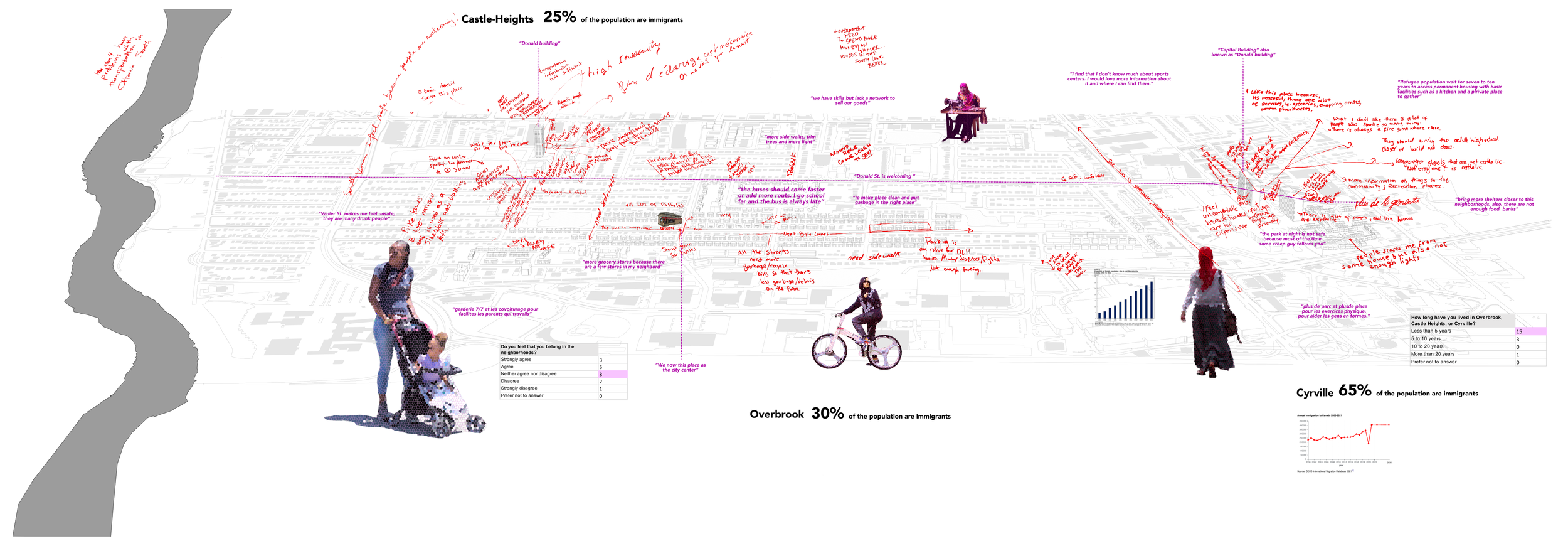
Rewriting Overbrook, Castle-Heights, and Cyrville. Ottawa, Canada. CC: All rights reserved.
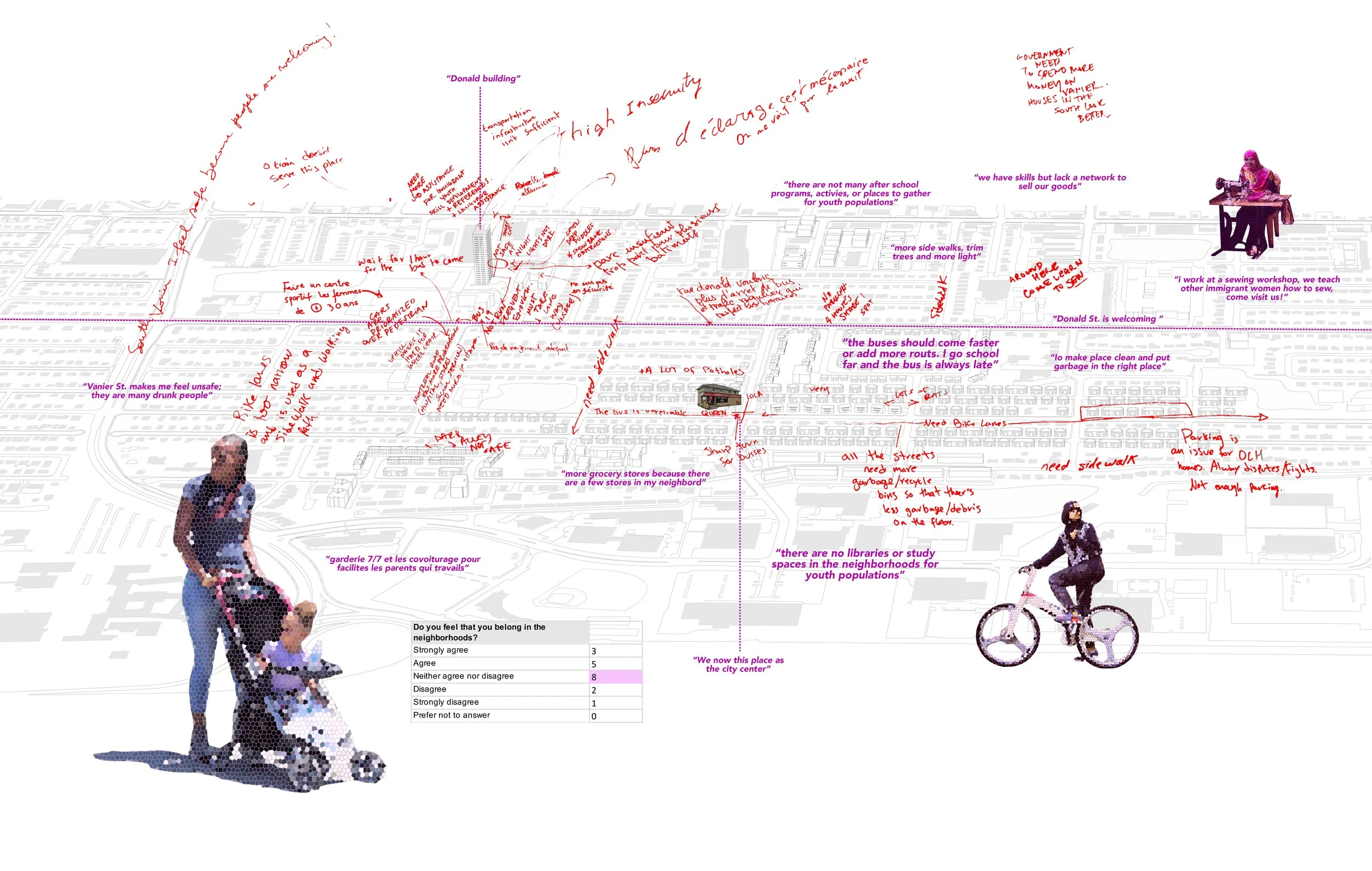
Rewriting Overbrook and Castle-Heights (CC: All rights reserved)
Published at: Escobar, N. “Undoing White Settler Designed Cities: Mapping with Racialized Immigrant and Refugee Women in Canada,” ACSA 112th Annual Meeting: Disrupters on the Edge Proceedings, Vancouver, 2024.
MAP SECTION: CYRVILLE
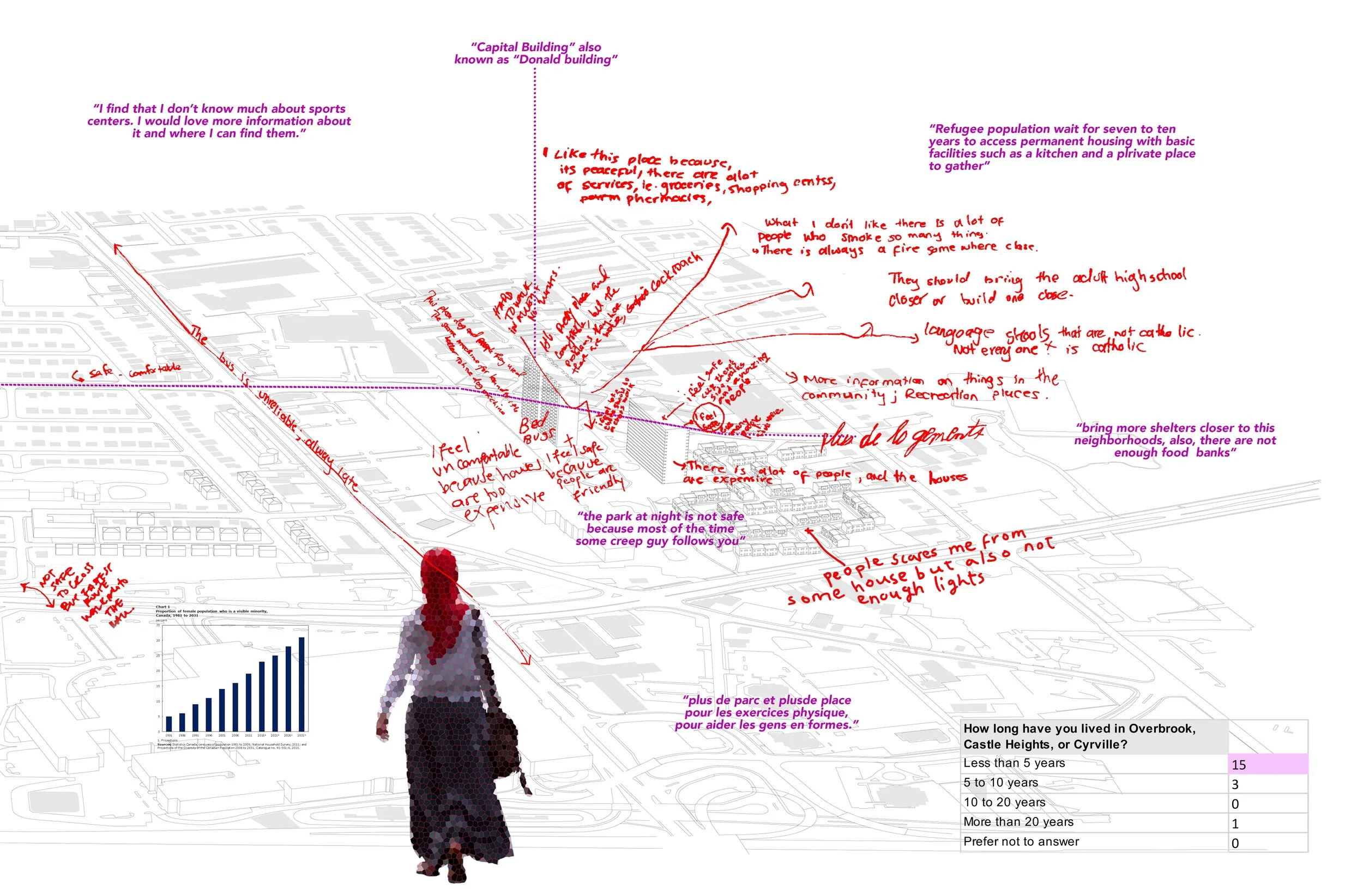
Rewriting Cyrville (CC: All rights reserved)
Published at: Escobar, N. “Undoing White Settler Designed Cities: Mapping with Racialized Immigrant and Refugee Women in Canada,” ACSA 112th Annual Meeting: Disrupters on the Edge Proceedings, Vancouver, 2024.

Rewriting the Santiago Municipality, Chile. CC: All rights reserved.
Escobar, N. “Reparative Mapping: Undoing the White, Patriarchal, and Classist City with Diasporic Women in Chile.” Material Arquitectura, Volume 26, Universidad de San Sebastián, forthcoming 2024.