RESEARCH PROJECT:
INTERSECTIONAL GIS MAPPING
In the the settler state of Chile, governmental statistics show that the immigrant population has doubled since 2017 reaching 1.6 million people in 2022, and population projections show that one-fifth of the population will be foreign-born by 2030. The amount of immigrant women and men entering the country is almost equal, and mostly their ages range between 25 and 39 years old. Most immigrants come from Venezuela (32.8%), Perú (15.4%), Colombia (11.7%), and Haiti (11.4%), nationalities that are frequently racialized in Chile. In 2020, the government passed an Immigration Law to reduce international immigration, particularly from Venezuela and Haiti (Ley de Migración y Extranjería, 2021). However, since many immigrants are fleeing their countries due to political and economic crises, the law has mainly resulted in a higher number of immigrants with no state protection or rights, bringing questions of urban equity to the forefront, 2023.
The maps below use Geographic Information System (GIS) to map census data to create demographic maps of the Santiago metropolitan area that looks at gender, immigration, country of origin, and economic status. The last map highlight areas where recently arrived women immigrants (refugee and first generation), racialization and economic vulnerability intersects. In a second part of the study, these areas are addressed through participatory mapping workshops that centers the voices of people.
Case-study: Santiago metropolitan area, Chile

Urban Distribution of immigrant populations per nationality, Santiago metropolitan area, Chile. (CC: All rights reserved)
Natalia Escobar Castrillon with Stefano Romagnoli (Region Austral), and Sofía Ugarte (Cambridge University)
Escobar, N. “Reparative Mapping: Undoing the White, Patriarchal, and Classist City with Diasporic Women in Chile.” Material Arquitectura, Volume 26, Universidad de San Sebastián, forthcoming 2024.
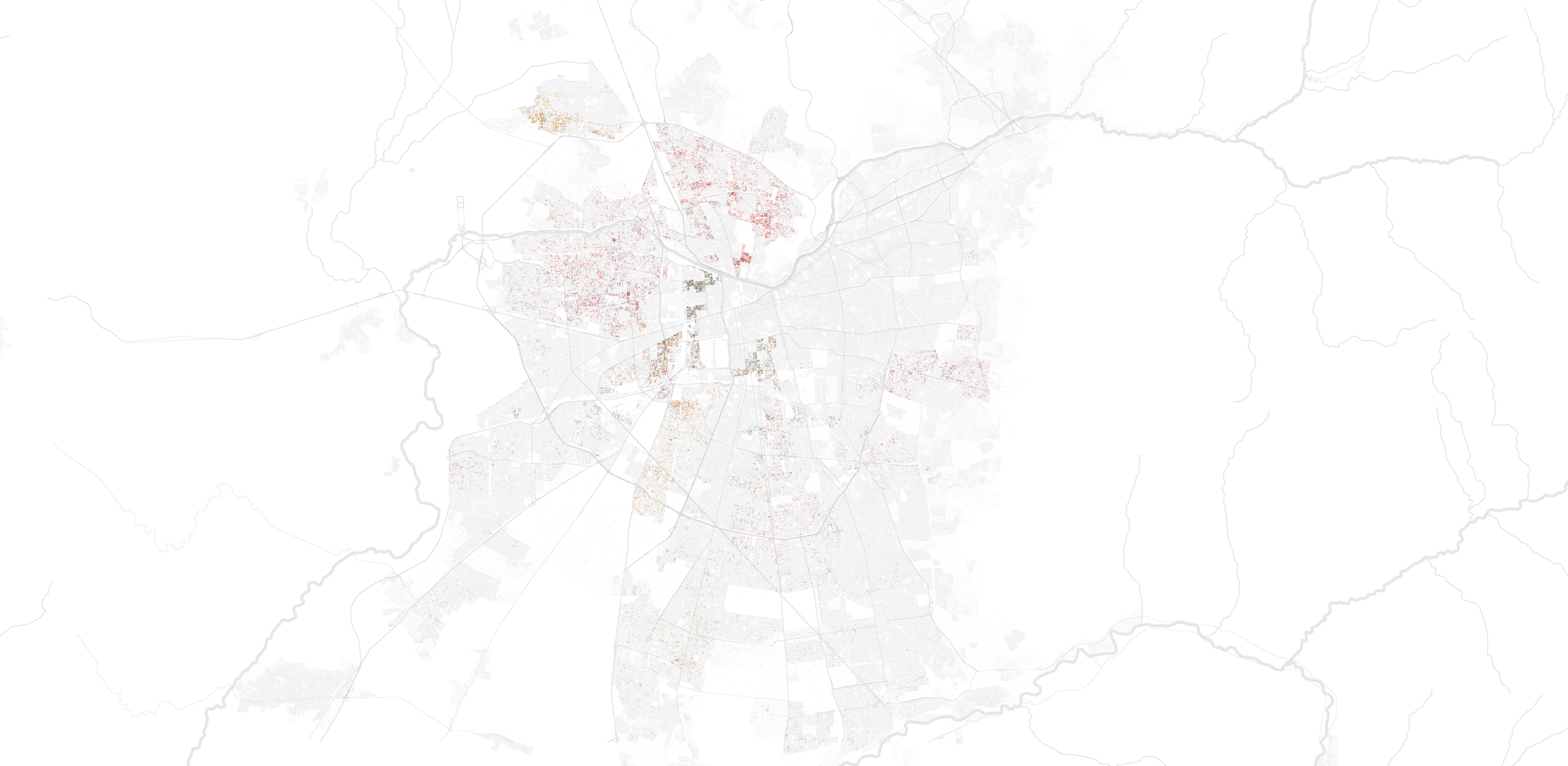
Urban Distribution of immigrant women per nationality in areas of economic insecurity, Santiago metropolitan area, Chile. (CC: All rights reserved)
Natalia Escobar Castrillon with Stefano Romagnoli (Region Austral), and Sofía Ugarte (Cambridge University)
Escobar, N. “Reparative Mapping: Undoing the White, Patriarchal, and Classist City with Diasporic Women in Chile.” Material Arquitectura, Volume 26, Universidad de San Sebastián, forthcoming 2024.
Supported by the non-for-profit organization the Inter-American Development Bank and Carleton University